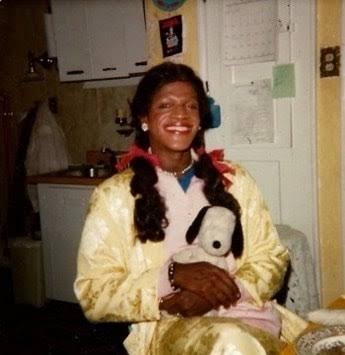
 One of my favorite images in the world is this photo of Marsha P. Johnson clutching a Snoopy doll from 1987. She’s in a yellow bathrobe, red bows punctuating her pigtails, and the most jubilant smile graces her face. Who couldn’t be happy holding Snoopy?
This cozy Polaroid from decades past is a great example of trans joy and what it can do. One glimpse at it and my day feels a little brighter. After enduring so much in the world, navigating countless challenges, and even being ostracized by the larger LGBTQIA+ community, Johnson still accessed bliss.
Having easy access to these kinds of bursts of joy that make one feel instantly a little lighter and more hopeful are as vital now as ever. No matter who you are, the American news cycle alone delivers countless reasons to despair. Just for trans people alone, Supreme Court rulings stripping away rights and visibility from this vulnerable community can make one not want to get up out of bed in the morning. Being a trans girly existing in Dallas, Texas, I’m often navigating loneliness in being the one trans person in cis-dominated spaces. Those emotions and anxieties have only increased in intensity in recent months.
Reality is brutal. We can’t ignore that. Saying the sky isn’t blue doesn’t automatically make it green. However, there are ways to cope and endure through these challenges. We can create better worlds than the ones we’re currently inhabiting.
Among the many reasons I’m grateful images like Marsha P. Johnson cuddling Snoopy exist is that they provide automatic visual comfort for when I’m feeling lonely, especially in those cis-dominant spaces. One look at the picture on my phone and I can remember, “Right, I’m not the only trans person who’s existed.” That might sound hyperbolic, but it truly can feel like I’m stuck in a trans-coded I Am Legend scenario wandering around certain North Texas spaces. Me sauntering into a Whataburger for a quick bite can lead to all eyeballs suddenly being pointed at me. My very existence is apparently an invitation for Lyft drivers to ask me invasive questions.
Even just looking around and realizing that the cishet folks outnumber me a hundred or more to one can ensure that loneliness creeps into my brain.
Loneliness is a domino that can collapse and unleash a wave of further catastrophizing-laced dominos. Suddenly, just walking across a room feels like crossing a desert. Every potential task I have to accomplish seems mammoth. Every tiny issue becomes a cataclysmic problem.
My defenses are suddenly up as I worry whether or not some cruel remark, unwanted cis-male advances, or, god forbid, violence is on the horizon. In places like fancy film festival parties, there’s no room for fun or escapism. Loneliness just consumes everything.
This is why I’ve come up with certain go-to tools to help me decompress, ground myself, and remind me of the wider world beyond those days where loneliness is inescapable.
One of these coping tools is an extension of that Marsha P. Johnson photo that brings me so much joy. There are all kinds of memories from my time spent with other trans people and best friends in super-gay environments that always bring me comfort. I’ve printed out snapshots of those memories and plastered them all over one of my walls.
Now, whenever I wake up feeling defeated and alone, I can gaze upon these photographs and remember great gender-reaffirming memories; reminders that the world is so much bigger than just what I’m feeling right now. There are days beyond this one.
Another great tool? Music. Putting on my big pink noise-canceling headphones and listening to tunes that bring me joy is a great way to navigate crowded spaces full of cishet people (not to mention give potentially invasive guys an immediate “screw off, don’t talk to me” signifier). Especially fun is whenever my playlists suddenly switch to melodies crooned by trans and lesbian women. I may be the only trans woman physically in this space, but suddenly I’m hearing vocals of the larger LGBTQIA+ communities I call home. These vocals beckon me to endure and remind me that I’m not alone, not so long as 100 Gecs is putting out new music.
Being around welcoming social spaces where I can interact with other queer/trans souls is also a balm after persistent loneliness and ostracization. Among the many amazing aspects of these gatherings is suddenly hearing your own thoughts, sensations, or experiences coming out of the lips of other people. It’s surreal realizing that the psychological experiences you previously thought only inflicted you are surprisingly common. Even as our brains or certain environments tell us we’re alone in this world, we’re never alone. None of us traverse this grueling reality alone.
This particular coping mechanism can be a lot easier to talk about than do, of course. For many, there may not be local social spaces catering specifically to your marginalized identity. But that norm defining the past doesn’t have to be the future. Speaking from my Dallas, Texas experiences, I’ve witnessed a deluge of queer women-oriented social organizations crop up in the last two years. There was a void in this city. Everyday people took it upon themselves to create the events and environments they wanted to see. Everyday people like you, dear reader. All of us capable of so much more than we might believe whilst in the throes of loneliness-induced anxiety.
Use whatever tools you can to organize and create these spaces, even if it’s just putting out a notice on social media for people to meet at a bookstores largest table one Thursday. This Eventbrite to-do list about organizing speed dating eventsexternal link, opens in a new tab can be a useful guide for putting together any kind of social event. You’d be surprised how many people show up when there’s an opportunity to curb back the pangs of loneliness.
Best of all, these gatherings can occur anywhere. In an Applebee’s. A bowling alley. A local Half-Price Books. A store that specializes in selling Pokémon cards. You don’t need to live in the biggest, most bustling cities to have these soul-enriching social endeavors. Any random Panera bread or thrift store can become a place where you and other people congregate. The world is more malleable than you can ever imagine. A routine shop for most people can become go-to backdrop for communal bonding between you and other folks undergoing similar circumstances of all stripes.
It is in these spaces that one can unearth the greatest coping technique for loneliness: communal bonding. Speaking from experience, reading the news on an average day can make one feel totally adrift. Even just confronting one’s mental health struggles after waking up and groggily sauntering to the shower can be an arduous trek. When we’re alone, all the worries stay in our head, they never get vocalized or discussed, and, as they fester, they become mammoth. They catastrophize and inevitably spiral out to include other worries about everyday life. I’ve been there and I’ve also constantly discovered that interacting with others is crucial to finding peace in the middle of the psychological turmoil.
Connecting with others helps not only ourselves, but everyone we connect with. We can provide the help and empathy to others that the world itself so often lacks. Just because forces like the US government or societal norms can be cruel doesn’t mean we need to continue that cycle. Bonds and kindness shared between human beings doesn’t erase all the loneliness, but it can make everything feel more manageable. After all, you’re no longer facing existential woes in a solitary fashion.
If that all sounds impossible or elusive given your current circumstances, I know exactly where you’re coming from. I’ve had days (especially in recent months) where despondence enveloped me and even the easiest coping techniques felt too formidable to engage with. It’s these experiences that underscore my conviction, though, in these coping techniques. As cornball as it might sound, it’s urgently important to cling to hope in the most challenging times imaginable.
Life’s unpredictability is often terrifying. It can also be beautiful. The same everyday chaos ensuring mental health struggles appear anywhere also provides reminders of existence’s beauty at the most unexpected intervals. We can also create reminders and community bonds that make heavy loneliness a much easier burden to carry. None of us are truly helpless or alone. Just ask Marsha P. Johnson and the Snoopy doll she loves so much.