When the wolf of fascism is howling at the door, it can be hard to find safety in anything around you. When the world outside is dark and scary and your own home might not offer you refuge, connecting with your body can be a place where you find safety and sanctuary. To talk about finding home in your body, I reached out to a friend of mine, Dirty Lolaexternal link, opens in a new tab, a real adventure of a human!
Dirty Lolaexternal link, opens in a new tab (she/her) is an award-winning sex “edutainer” (educator and entertainer) and speaker best known for her live sex ed Q&A show Sex Ed A Go-Go,external link, opens in a new tab and as a Sexpert on the Netflix docuseries The Principles of Pleasureexternal link, opens in a new tab. According to her website, Lola has “spent over a decade working to end the stigma and shame surrounding sex and sexuality. In addition to her educational projects, Lola is the Workshop Coordinator at SHAG Brooklynexternal link, opens in a new tab, on the advisory board for the Youth Sexpert Programexternal link, opens in a new tab, and has brought her unique brand of sex-positive sex education […]” to so many communities, brands, and teens across America and beyond.
I wanted to warn you that Lola and I are going to be discussing some potentially harmful subjects like sexual assault, body dysmorphia, and the like, so be mindful of your own feelings as you read along. (Here are a handful of articles that might be an easier, yet fulfilling read!)
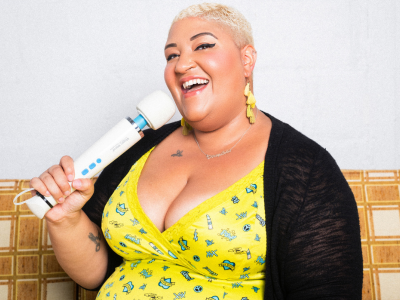 Dirty Lola has always been “the weird kid.” As a teen in the 1990’s and early 2000’s, she expressed herself through her clothing, her hair, and her queer friend group.
“I blame John Hughesexternal link, opens in a new tab for my sense of self. The dorky kid that always came out on top? I would be sad that I wasn’t accepted by everyone, but that didn’t curb my weird. Being around people who were also weird was what really made me fall in love with my body, mostly because we didn’t talk about bodies like that. They would say, ‘You’re beautiful.’ I’d say back, ‘I’m fat,’ but then they would reply, ‘I said you’re beautiful.’ As a perpetual dieter and little girl who received workout kits for Christmas, it was amazing and so many people don’t get to hear that from their friends.”
“My weight never stopped me from going after boys or girls or whatever I wanted,” she stated, so confidently it was hard not to feel a little empowered myself (as a fellow fat queer person). “I’ve always known I had worth. I wasn’t locked into that echo chamber of self-hatred fed to teenagers. I would just think, ‘the people who love me wouldn’t say this about me. The people who love you will validate you and tell you when you’re being cruel to yourself.’”
Finding community like that sounds easier said than done, but it starts with knowing who and what you are and finding confidence in that. I mentioned that in choosing friends, I always looked for those who “improved my solitude” and Lola agreed. “I would struggle to look at my body and my friends would push me to talk to people and combat my shame.”
She started her own personal sex education through books like R.L. Stine’s venture into teen literature, Fear Streetexternal link, opens in a new tab, and V.C. Andrews’ Flowers in the Atticexternal link, opens in a new tab. As a survivor of childhood sexual assault, she said, “my trauma became a hyperfixation which resulted in a hypersexualization of myself.” She went on to say that although there is a huge stigma towards survivors of SA finding solace and sanctity in their bodies through sexuality, each person’s reaction to that trauma is their own and cannot be compared to anyone else’s.
“Sex education when I was a kid wasn’t really a thing. It wasn’t done by sex educators or anyone who had any expertise on sex itself. It was normally the gym teacher that got wrangled into following a state-provided curriculum. They didn’t teach porn literacy to help us understand what was real and not real and they definitely didn’t teach anything about the clit— but, whoah! Did we learn about the ovaries! People with penises didn’t get anything in those classes. Maybe a technical explanation of sex, but nothing useful. And we definitely didn’t get any education about transness, queerness, or queer sex.”
“What my idea of sexy was didn’t match the status quo, so I went and made it my own.” This hill became the base upon which she would build her life’s work.
Or, at least she would in her thirties. For those of you who might worry that your life won’t truly begin if you don’t have a 10-year bullet-pointed plan by the time you’re seventeen, Lola, whose personality and voice are bubbly and full of unabashed joy, said, “It wasn’t until my thirties when I thought to myself, ‘Wait. This could be a career!’”
“I hit my quarter-life crisis. I realized I was kinky and polyamorous—people didn’t talk about non-monogamy in 2010, you know.” She became so outspoken and knowledgeable that her friends started asking her questions about how to navigate their own sex lives and relationships. Her blog “Story Time” was born. “I would always joke,” she laughs, “people would come for the titties and stay for the knowledge!”
This developed into a sizable online following and, being chronically online, she eventually discovered the the Catalyst Conferenceexternal link, opens in a new tab (a sex-positive and inclusive conference for sex education professionals which is now defunct) which she first attended in 2013 which she says, “broke [her] open”. “They didn’t just talk about one thing. They had swingers, kink, trans people, it was all there! I was overwhelmed!” This is where she met other sex educators who would help shape her purpose like Ducky DooLittleexternal link, opens in a new tab, Carol Queenexternal link, opens in a new tab, and Dr. Jocelyn Eldersexternal link, opens in a new tab.
She immediately began to host burlesque shows in NYC which helped get her creativity bubbling. That work eventually evolved into “Sex-A-Go-Go” when she teamed up with Francisco Ramirez external link, opens in a new tabwho “took [her] ideas and brought them to life through imagination.”
I’ve had the pleasure of attending several Sex-A-Go-Go events, so let me paint a picture for you. When one first arrives at Dirty Lola’s Sex-A-Go-Go, they are immediately greeted with a handful of local artisans selling body-inclusive and sex-positive art pieces and clothing as well asrepresentativesexternal link, opens in a new tab from personal pleasureexternal link, opens in a new tab toy manufacturersexternal link, opens in a new tab, queer zine external link, opens in a new tabmakers, and trans and BIPOC-focused adult videoexternal link, opens in a new tab production companies. There is a box in the front that says “Got a question?” with blank sheets of paper and pencils right next to it, ready for attendees to write their personal inquiries to be anonymously offered for discussion. Once everyone settles into their seats, Lola’s boisterous voice fills the rooms and introduces her guest panelists for the evening (people like Maggie McMuffinexternal link, opens in a new tab, Rain Supremeexternal link, opens in a new tab, and of course, Francisco Ramirez). Her panelists offer a little of their backgrounds, their expertise, and silly little anecdotes to help the room feel at ease. Finally, they begin to reach into The Box™. Questions about kink, intimacy, relationships, fear of rejection; nearly anything you can think of are offered to the audience and to the panelists who discuss what their experience has taught them about these struggles. No one is called out, no one is embarrassed. The audience can add thoughts or ask clarifying questions, and when the discussion is over, little goodie bags full of condoms and artsy stickers are collected and the attendees head out into the world with a broader understanding of sexual expression and intimacy than they came in with.
They’re really… really lovely events. I hope you have a chance to attend one some day!
Eventually, I asked Lola how can we love ourselves and our bodies when the entire world profits from us hating both.
Let’s start with our bodies themselves. Many of us grow up with body hate fed to us from photoshopped ads, celebrities posing as models of health, and diet culture. It may seem like an incredibly steep jump to switch your mindset from hate to love, but there is a whole spectrum of association within that. “We can go from body hate to body neutrality,” she says. “Saying things like ‘this is a body and it gets me from point A to point B.’ When you can feel neutral about your body, it’s a lot easier to start trying to like it.”
It brings me to one of my favorite songs, “My Body’s My Buddyexternal link, opens in a new tab” by Tessa Violetexternal link, opens in a new tab, Bryeexternal link, opens in a new tab, and Corookexternal link, opens in a new tab. Like when we spoke with Kal Mendoza and they mentioned that sometimes you just need to take the time to breathe and feel your own skin within the world you’re in, once we can take breaks from hatred of our bodies and our sexualities, it becomes easier to find homes in them.
Of course, that is more easily said than done. Our society’s entire beauty industry hinges upon the idea that most people need “editing”. The things that make you different from the Eurocentricexternal link, opens in a new tab comphet (short for compulsory heteronormativityexternal link, opens in a new tab) norm—gender expression, queerness, transness, race, weight, disability, the list goes on—are often targeted as things that need to be quieted and/or fixed. This also translates into an adult film industry that presents entirely unrealistic, unrelatable, and often times harmful representations of sex and intimacy that really require folks to work on developing something called “porn literacy” (another article here).
When Lola and I were discussing how straying from the “norm” often leads to young people feeling unmoored or isolated, I brought up how sexuality and sex itself is often discussed through this same lens. There are movies where thin, often white, cisgender, strictly homosexual characters are depicted experiencing pleasure and healthy relationships, but often times people who don’t fit in that narrowly “acceptable” mold don’t get to see themselves on screen (or in books). For example, how does someone who is disabled develop a sense of healthy sex or relationship dynamics, much less porn literacy, when they never see it shown in the world they live in?
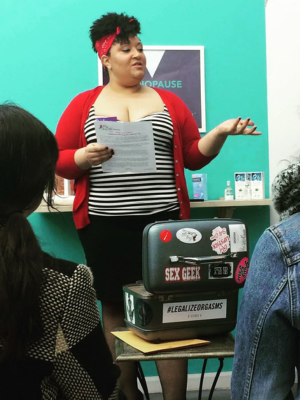 Lola replied, “They exist! If that’s what you’re looking for, find disabled models, authors, married disabled people. Whatever representation you need, search for it and find inspiration so that you can live the life you want. You just have to look and not accept only what gets shoved at you by the media.
Here, I give you a beacon of permission to get started! If you can find even a glimmer of what could be, it makes it so much easier to dream. Reach into your communities and into stories. You are never entirely a fish out of water. Reading about and meeting people who are like you help you find your identity. If people in the past have gone through whatever it is, that strength is passed onto you.”
This thread of ancestral strength has been ever-present in every interview I’ve held thus far. There are so many who have come before you who have struggled against the same types of battles and won and we, in this generation, have inherited their resolve and fortitude. We don’t have to start from scratch.
“Start with something small. I started with a ‘Strutting Playlist’: music that made me feel comfortable and sexy and I would walk around in my clothes. I mimicked the body language of confidence and interest until it became a habit. This will be painful and uncomfortable, so you have to be kind to yourself.”
What kind of kindnesses can you offer yourself? Can you already imagine the songs on your own “Strutting Playlist”? Do you go out of your way to consume media that speaks to the parts of you that seek joy and wonder in the world? Can you give yourself permission to find success and expression in baking, painting, hiking—whatever brings your heart levity?
With all the societal pressures to conform and shrink ourselves, it will feel strange at first, like wearing shoes that need to be broken in.
And just like breaking in new shoes, “strutting” might be uncomfortable at first! In fact, it may feel like too much of an ask and that is completely understandable. Lola didn’t pop into the world out of the ether with overflowing confidence, she had to learn it. She had to practice self-appreciation until it became a skill and for some people, that takes extra steps. If you’re starting your self-appreciation journey at a level of self-loathing, it might seem impossible to find a way to love yourself the way Lola does. So perhaps finding a level of self-neutrality might be an easier ask. Making peace with your body without judgment could sound like, “I have a body and it gets me from one place to another.” Or even, “clothes are just fabrics that sit on my skin and the amount of fabric used does not have morality.” Even something like, “I will not shame or hurt myself today” can be a great fact-oriented, non-judgmental mantra to start with.
No matter what level of self-love you begin at, making the choice to make peace with your body, and the things that bring it pleasure, is sometimes the hardest, but absolutely the most rewarding step, you can take.
All in all, finding sanctuary in yourself and your sexuality is actively battling against the oppressive forces that wish to push you down into a little box that you are too grand and too full of life to fit in. The best part of starting this journey? The fact that you have never been and will never be entirely on your own. Your village already exists and no matter where you are, there are people just like you who are sexual, sensitive, and safe.
Lola ended our interview with one last nugget of joy.
“Find your community wherever you can. And if you have to side-eye God, you do it, and know that where you are isn’t where you always will be.”