Using a condom is easier than it looks, but the first few times, it can be tricky, especially if you’re nervous about knowing how to use one, or have never even opened one before. It’s important to know how to use condoms like a pro, to assure that they work to help prevent unwanted pregnancy, sexually transmitted infections or both, and because you want them to feel as good as possible for both partners. No matter what your gender is, or what your partner’s gender is, if one of you has a penis (or you both use a toy), knowing how to use a condom properly can make you safer and can make a big difference in your relationship.
Do yourself a favor – if you’re the person whose body part or toy a condom is going on, try it at home by yourself first, without the pressure of being watched, without worrying about losing an erection, or without the uncomfortable feeling that you’re being graded on your condom skills. You or a partner can also practice on a banana (silly, we know: but hey, it works!) with the same condom until you get it right. Either or both of you can put the condom on when the time is right, so it’s good for everyone to know how.
Condom use is just like tying your shoes: tying them all the time may be a bother sometimes, but if you don’t do it, you’ll trip and fall on your face. The consequences here can be far worse. A few STIs are incurable, and once you have them can create some health issues you may need to deal with for your whole life. A couple of them can shorten that life, and all of this also goes for your partners (and their partners, and their partners…). All of them can impact your health and the public health and cost you time, energy and money to deal with.
If you’re in a relationship with an opposite-sex partner, and condoms are your only method of reliable birth control, I don’t need to tell you why they’re important, even when you’re not the one who can wind up pregnant. One fantastic thing about condoms is that they are one of the only methods where both partners can share responsibility when it comes to birth control. They also make an excellent backup when using other methods. So, here’s how to do it right.
The basics:
1) Use a good quality condom that is new, and well before the expiry date. Every condom has an expiration date on the package, so just take a look at it before you open one. be sure you’re also using a condom that hasn’t been kept anywhere where it can get worn or too warm or cold (it isn’t a good idea to keep them in your car, wallet or pocket for that reason).
When you first buy condoms, see if you can get a few different brands and styles for yourself. It can take some trial and error to find the kind that best fit you and feel best, so getting assortment packs, or a few small boxes of a couple different kinds is a good idea.
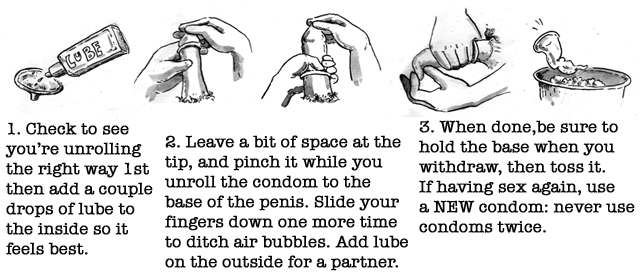
2) Open the condom wrapper carefully with your fingers, and roll it out a little so that the edge is rolled on the outside of the condom. That rolled-up edge needs to be on the outside, facing up, or the condom won’t roll down right. Put a few drops of water-based lube (such as Astroglide, KY Liquid or Liquid Silk) inside the tip of the condom: that not only helps with getting it on, it makes condoms feel a lot better during use. Only put a condom on AFTER there is a partial or full erection (after the penis has “gotten hard”).
3) Squeeze the tip of the condom with your fingertips to leave some extra space in the tip, and roll the rest down the length of the penis, while still pinching the top. The rim of the condom should be as close to the base of the penis as possible. When you’re down to the base, run your fingers from the tip all the way down to press out any air bubbles: this helps keep condoms from breaking.
4) Put some more latex-safe lube–lube that doesn’t contain any kind of oil–on the outside of the condom, and you’re good to go. While you are using the condom, neither you nor your partner need to hold onto its base: condoms are designed for hands-free use.
5) After ejaculation (or not, but you’re finished having genital sex) – before you withdraw – hold the base of the condom (the rolled-up part) with your hand. If you withdraw without holding the base, the condom could slip off.
Keep your hand there while you withdraw, and until the penis is all the way out of the vagina, anus or mouth. Pull it off with that same hand on the rim of the condom and your other hand by the tip. Pulling it off by the tip alone not only makes a big mess, you could drip all over yourself what you just worked so hard to keep out. Tie a knot near the base of the condom.
6) Throw the condom away in the rubbish bin - NEVER reuse condoms. And please don’t just toss them outside a car or in a park: not only is that just plain gross and uncouth, it’s unhealthy for the rest of us. (Plus, that also means that now and then, as happened to me when I used to teach Kindergarten, some poor teacher winds up with some little kid finding one, waving it all over everyone and everything, and then said teacher having to quickly come up with a very good story about what exactly the “slobbery balloon” is, knowing her wee ones have just been exposed to gawd knows what.)
Never put two condoms on at once to try and be “extra safe”. Both of them will most likely break due to extra friction, and it just doesn’t work or feel very nice for the wearer. One condom, used properly, is as safe as it gets.
If that isn’t safe enough for you, don’t have sex yet where you need one – stick to outercourse – or, if it’s about birth control worries, back up condoms with a second method.
Some extra tips:
• You or a partner being allergic or sensitive to latex does NOT mean you can’t use condoms. It just means you need to use condoms made out of another material. The female condom is nonlatex, and there are a couple brands of male condoms (like Avanti or SKYN) which are also not made out of latex, but which provide just as much protection for you and yours. “Lambskin” condoms, while nonlatex, don’t provide protection against STIs, so those aren’t the best choice.
• If you are uncircumcised, gently push your foreskin back – only to the point where it’s comfortable – while you’re putting the condom on. When the condom is unrolled about 1/3 the way down the shaft, with one hand pull the foreskin together with the unrolled part of the condom upward while with the other hand unroll the condom to the base of the penis. That way, the condom will allow the foreskin to move as it should. It sounds a lot harder than it actually is – just practice a few times first and you’ll get the hang of it.
• Lubrication is really important. Let me say it again: lubrication is REALLY important.
Condoms have a high rate of success, but that rate drops when they aren’t used properly, and one of the easiest ways to break a condom is by letting it get dried out. Buy some lubricant when you buy condoms. Not only will it help them work better, well-lubricated sex is generally more enjoyable sex for both you and your partner. Even if a person who has a vulva is plenty wet on their own, our own lubrication doesn’t tend to work as well (or last as long) with condoms as the stuff made for condom use does. Even when a condom is already lubricated, it’s a pretty stingy amount of lube. Do NOT use butter, oil, body lotion, Vaseline or ANY lubricant other than lubricants intended for use with condoms. If you could buy it in a store aisle where food is displayed, it isn’t the right kind of lube.
• Condoms don’t have to be a pain. Don’t try and rationalize your way out of using one, or put up with a partner who does: you’ll both need to get used to using them for a good part of your life, and even if one partner lets you get away with it, you can be sure another one won’t. Bad attitudes about condoms also tend to form a self-fulfilling prophecy, making them seem like more of a drag than they are.
Condoms keep both you and your partner safe. They’re one of the least intrusive kinds of birth control there is for people of all genders when it comes to sexual side effects. And when you don’t have to worry about getting diseases or getting pregnant, sex is a lot more fun. Being a partner who steps up to the plate and just puts on a condom, without a partner having to beg, cajole, nag or argue, also shows a level of maturity and care most folks are looking for in someone they sleep with. Once you get used to using condoms, it’s a total no-brainer, and when you’re using good condoms properly, they really don’t make a huge difference with sensation.
• You should also wear a condom during oral sex just as much as during vaginal or anal sex, especially with new partners. Most STIs are transmitted through bodily fluids and mucus membranes… both of which exist in and on your genitals and your mouth. While there are more STIs transmitted via direct genital contact, and the risks are higher with vaginal or anal intercourse than with oral sex, there are plenty which can be transmitted orally.
• If you’re a woman who sleeps with women and you use sex toys together which cannot be sterilized through boiling, you’ll want to use condoms every time to cover those toys. While cisgender lesbians have far lower risks of STIs, BV–bacterial vaginosis–in particular gets passed around a lot between women, and if you’re sharing toys, that’s an easy way that can happen. Keeping the toys clean, or covering them if they can’t be cleaned to the point where all germs are killed, keeps everyone safe and healthy.
• Not only do thinner condoms feel better, but because they cause less friction they’re also less likely to break. Yippee! Remember that you don’t have to stick to old-style, plain condoms. The thinner condoms, or those with textures, are just as safe as the plain ones, and many people enjoy the feeling of newer styles better. Want to read about the different styles of condoms to find out what might be just right for you? Check it out!
• When it comes to condoms, don’t scrimp. If you can’t afford them at all, check out your local Planned Parenthood, other sexual health clinics or even community centers or school nurse’s offices. They often give them out for free. And if you find when you go to use a condom you have that it’s broken, or was already opened, or has some other flaw, don’t gamble. Either get a new condom that IS in perfect shape, or if you only have that one, nix sex that requires condom use until you get working condoms.
• Hey, Women! Do yourself and your partners a favor by having your own stock of condoms: don’t be passive and rely on the guys to get them or always have them around. Condom sales studies show that the majority of the time, condoms are purchased by men, and we often counsel folks here through pregnancy scares because two people found they both were relying on the other to be in charge of condoms, and neither were prepared. If women and men alike take charge when it comes to having condoms around, it not only helps prevent finding yourself in a precarious situation, it also empowers both to be in the driver’s seat when it comes to sex together, which makes not only for better sex and relationships, but for feeling better about sex and shared, equitable responsibility.